In less than 21-hours I board my flight to Los Angeles so as to join about 25% of the rest of the group of 40 teachers then heading on to Seoul, South Korea. The full group of 40 (others flying in from Chicago and New York) will meet at the airport in Seoul.
So today I spend my final moments of preparation. I have errands to run and a lesson plan to finalize. I finished all of my laundry early last week before a very fast paced trip to Indiana and Michigan, so this evening I'll have a little bit of ironing and packing to do: one or two suitcases??...I'll figure that out tonight.
Otherwise...I'm ready to go. I'm excited to say "goodbye for now Oklahoma and 인사말 한국 (greetings Korea)!" Let's do this!!! My passport is READY for some remote road roaming.
Monday, June 24, 2013


Monday, June 17, 2013
Itinerary for Korea
I just received an e-mail a little while ago with the most up-to-date itinerary for my upcoming trip to South Korea. Here is a taste of what I'll be getting to see:
 |
| Korea University |
 |
| National Museum of Korea |
 |
| Royal Tomb of King Sejong in YeoJu |
 |
| Early Printing Museum in Cheongju |
 |
| Cheonmachong Tomb |
 |
| Kyungju National Museum |
 |
| Bun Hwang Sa |
 |
| POSCO Company |
 |
| Seokguram Grotto and Bulguk-sa Temple |
 |
| Yangdong Village |
 |
| Ok San Seo Won |
 |
| Haeinsa Temple |
 |
| Demilitarized Zone |
Sunday, June 16, 2013
Korean Games
 Nearly every culture has some form of games unique to their culture or a modification of something similar in a neighboring culture. It is estimated that nearly 70% of Korean traditional games originated within the winter months; this seems logical since most people found themselves in doors to keep warm and needed something to help pass the evening hours.
I'm interested in learning, or a least seeing them in action, the following games:
Janggi is the Korean version of chess which was introduced from Mesopotamia through the Chinese. Men can often be seen crouched over engrossing games along sidewalks and in parks. Each player has 16 pieces: 1 general, 2 chariots, 2 cannons, 2 horses, 2 elephants, 2 palace guards, and 5 soldiers, each of which is represented by Chinese characters written/carved on checkers. The object is to checkmate the general.

Baduk is a contest of wits between two players to occupy more territory (houses) on a board divided by 19 vertical and horizontal lines. Black and white button-like stones are used as the markers. Once exclusively the game of the high officials during the Goguryeo and Baekje days, baduk increased in public popularity after 1945. Baduk halls have now been established in almost every town.


Hwatu is the name given to Korean playing cards. A pack consists of 48 match-book sized cards, representing the 12 months of the year: January--pine tree, February--plum tree, March--cherry, April--bush clover, May--orchids, June--peony, July--iris, August--the moon, September--chrysanthemum, October--maple, November--paulownia, and December--rainfall. A bit of gambling often helps to spice up the game. These flower cards are also used for fortune-telling.

Yut is a form of backgammon that is often seen being played by old men sitting in the street. Four 10-inch sticks used as dice are tossed in the air, and the player moves his pawns according to the number of backs or faces that turn up on the sticks. The first player who gets all four of his pawns to a goal wins.

Yeon Nalligi, or kite-flying, has long been a pastime in Korea, both for children and adults. In the past, soldiers and the upper classes used fighting kites to hone their battle strategies. The goal of Korean kite fighting is to maneuver your kite so that it cuts your opponent's kite string (typically made of silk). A favorite location for kite flying is the Hangang Citizen's Park in Seoul (home of the International Kite Festival in the first month of the lunar year).

Game playing...one way to do some great remote road roaming!
Liquid Courage
For a different way of looking at life in South Korea, here is an episode of an American show called "Three Sheets". The show's host travels the world and presents, each in a different episode, the drinking habits of the local populations.
One of the other teacher fellows in the Korea Society sponsored trip shared this video, primarily for our mutual entertainment. However, it does have some good cultural nuggets within the presentation. Enjoy!
Friday, June 14, 2013
Siska Hasheosseoyo?
External of my fear of chopsticks, I am very excited about the wonderful foods that await me in Korea.
As part of my continued preparation for this trip I've been reading a great travel book and have learned somethings about Korean food and dining behaviors that I was either not previously aware or did not fully understand.
For example, while I knew (based on my 2009 trip) that rice is served with nearly every meal I was not aware of the importance that rice played in the meal. Apparently, Koreans view rice as the main dish of the meal rather than a meat or other protein based item as would be considered the primary dish in Western cultures. In fact, the title of this blog "Siska Hasheosseoyo?" is a common Korean street greeting and literally translates to "Have you eaten rice?" I'm glad that I like rice <grin>.
Following rice, kim-chi (sometimes "gimchi") is considered the next most important component to a Korean meal. Kim-chi is actually THE dish for which Korea is most well known outside of the peninsula (especially since rice is a major element to the diets of many other Asian cultures). Kim-chi consists of cabbage and white radishes mixed with red-pepper and garlic and then pickled to help preserve the concoction (Seoul Garden in Mid-West City, OK makes a very nice cucumber kim-chi). I've recently learned that kim-chi can be a great source of Vitamin C. Depending upon the season, other vegetables such as chives, pumpkin, and eggplant may go through a similar preservation process for a more "exotic" kim-chi.
Bibimbap is a dish that one of my friends got the other night at Seoul Garden and it looked wonderful; I am interested in trying this dish of boiled rice mixed with vegetables and protein (like bulgogi beef) and all served in an earthenware pot...sometimes a fried egg is served as a topper. A dish that I have enjoyed before and look forward to having again is kalbi short ribs which are marinated and barbecued similar to bulgogi. This brings me to the one item which I am most excited to eat is bulgogi beef (chicken and pork are other common ways to prepare bulgogi) which is essentially strips of red beef marinated and then grilled over a charcoal brazier. It's often spicy and those who know me well know of my love for spicy Cajun foods!!
The only time on my previous trip when I wanted to "give up" on Korean food was Thanksgiving night. That 2009 trip included the traditional American holiday and my body, perhaps nostalgic for family & traditional foods, was simply craving turkey. The first dish served at the very nice restaurant our group went to included squid. While I politely picked my way through the dish (along with the chopstick issues), I just wanted something "American". A friend in the group felt the same way and on the way back to the hotel he and I stopped at a "haven" of American culinary delights...McDonald's. The funniest part was that I walked in, noticed that they had a bulgogi burger, and ended up eating something with a Korean flare anyway <grin>.
I'm excited to get back over there and roam some of those wonderful culinary remote roads!!
 |
| "sticky" rice |
 |
| kim-chi |
 |
| bibimbop |
 |
| kalbi short ribs |
 |
| bulgogi beef |
The only time on my previous trip when I wanted to "give up" on Korean food was Thanksgiving night. That 2009 trip included the traditional American holiday and my body, perhaps nostalgic for family & traditional foods, was simply craving turkey. The first dish served at the very nice restaurant our group went to included squid. While I politely picked my way through the dish (along with the chopstick issues), I just wanted something "American". A friend in the group felt the same way and on the way back to the hotel he and I stopped at a "haven" of American culinary delights...McDonald's. The funniest part was that I walked in, noticed that they had a bulgogi burger, and ended up eating something with a Korean flare anyway <grin>.
I'm excited to get back over there and roam some of those wonderful culinary remote roads!!
Thursday, June 13, 2013
Chopstick Fears are Fading
A couple of days ago I wrote about my fears of chopstick usage on my upcoming trip to Korea. Included within that post was invitation to join me out to eat so I can practice. Thus far, I have had one set of friends go with me to Seoul Garden, a Korean restaurant in Mid-West City, OK (click here to read about that experience). I have also gone to my local Pei Wei restaurant (I just love BOGO coupouns) and enjoyed a Spicy Korean Chicken in the restaurant and used a BOGO to bring home some Caramel Chicken; chopstick usage occured with both!!
My practice is getting me closer to perfect...granted "perfect" is still a long ways off. Let me know if you want to dine out at an Asian place over the next few days!!!
My practice is getting me closer to perfect...granted "perfect" is still a long ways off. Let me know if you want to dine out at an Asian place over the next few days!!!
Wednesday, June 12, 2013
Community Spirit in Face of Tragedy
As part of my upcoming trip to South Korea I am supposed to prepare a lesson to teach in an English speaking class at a local high school. The topics of our lessons was left open for each individual U.S. teacher. Something hit me that perhaps the recent events in the community of my school & students would provide an ideal platform for a lesson.
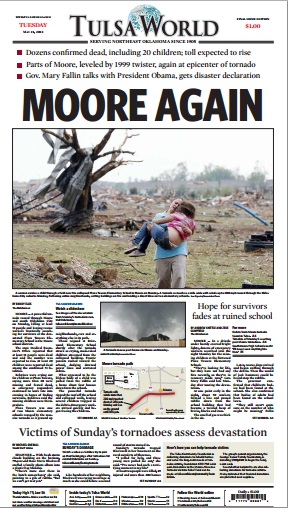
I began thinking about natural disasters and the way that communities respond and help each other to overcome the disaster. "Community" can be a very broad term to include just those in the immediate vicinity all the way to interpreting "community" as a common bond of human spirit across the planet. So that the lesson is relevant to my Korean students I don't want this lesson to solely focus on the F5 tornado which hit Moore, OK on May 20th. I've already begun researching natural disasters which have impacted the Korean Peninsula over the last decade or so: events which include a few typhoons (we call them hurricanes) and a massive flood in Seoul in 2011. I hope to work these events into the lesson so as to help my Korean students make local connection with international events; I also hope to refine and replicate this lesson for my students back at Southmoore.
In preparation, I've found these images of front pages from newspapers in the aftermath of the May 20th tornado. The Newseum, my current favorite museum in Washington, DC, has archived these images on their website. I'm working on the best way to incorporate them into my lesson. If you have any constructive ideas to help flush out this lesson please leave them in the comments section below; honestly, your insight is greatly appreciated


Tuesday, June 11, 2013
위로 이동 Gutenberg
 (title translation: "Move Over Gutenberg")
While I've known this before, Johannes Gutenberg was not the first to invent a printing process based on movable type. Such information was even included in the Gutenberg Printing Press Museum I visited in Mainz, Germany in 2011. I know this is shocking to many of my readers who are so steeped into the lore of Western History's slant on the existence of the planet.
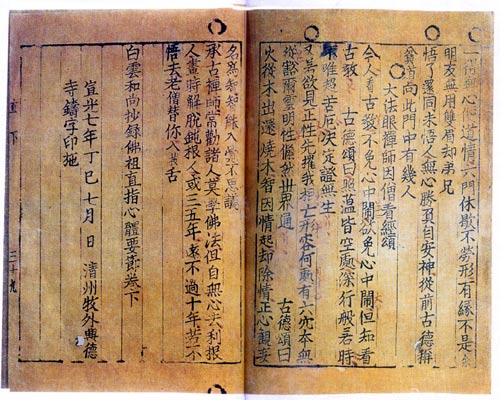 About 600 years before Gutenberg developed a movable type printing press in central Europe, the Chinese were transitioning from carved wooden blocks to ceramic blocks for printing purposes. Then 400 years later, still 200 years prior to Gutenberg, the Koreans took this Chinese technology and made it even more modern by creating metal blocks for their alphabet.

Regardless of who did it "first", the ability to produce reading material in an ever increasingly rapid manner has had a significant impact on the increase in literacy, education, and thus economic development throughout the world. When more can read more understand. When more understand they act.
For more information on the historic importance of metal movable type within Korea, check out this World History unit from the Annenberg Foundation. If you watch the pop-up Video on Demand, the portion on Korea begins at the 10:50 minute mark.
For more information on the historic importance of metal movable type within Korea, check out this World History unit from the Annenberg Foundation. If you watch the pop-up Video on Demand, the portion on Korea begins at the 10:50 minute mark.
Chopstick Fears
 I've NEVER been good with chopsticks; by NEVER I do quite literally mean NEVER. And to be honest, this has never caused me significant concern until my first trip to South Korea in November of 2009. I'd been to India, Thailand, and Hong Kong as my only Asian destinations; chopsticks are not prevalent in India and most of the places in Thailand or Hong Kong I went catered to western tourists (I guess) and were very hospitable with forks.
 |
| I didn't look this cute using my cheaters. |
Well, let's just say there were two problems with using these cheaters in South Korea: 1) the laughter and ribbing from my U.S. teacher colleagues, while all in good fun, was sort of embarrassing and 2) the cheaters were designed for a more traditional rounded Chinese chopstick set rather than flatter Korean styles. The cheaters just didn't want to work for me. It was like the fates were out to get me. I wanted to use chopsticks, I tried to use them, I wanted to be culturally appropriate...but I usually ended up having to ask for a fork or make due with the soup spoon which accompanied the chopsticks.
 And then about a year or so ago I was in a Asian restaurant and thought "let's try again" and WOW. I was actually able to manipulate the chopsticks enough to get through about half of my meal. It doesn't always work out; I often make a mess and grow tired of the struggle with the first couple of bites. But at least now I have "hope". Last week I was eating at Yaching's in downtown Louisville and made it through virtually my entire meal (including rice! with no cheaters!!!). I was excited and wanted to do a happy dance...but it's Louisville...land of the Kentucky Derby...you don't happy dance you happy gallop or something, LOL. I guess the excitement got me all inspired because upon my return to Oklahoma City on Saturday I went to Dot Wo with my mother and was eager to try the chopsticks again...eh...I made it through part of the meal...no rice success...and then forked it.
So with my upcoming return to South Korea and the land of flat chopsticks my fears are setting in. I am committed to NOT taking any cheaters. I just hope the fates smile on me so that I don't embarrass my hosts and colleagues and so that the food makes it, even if only quasi-gracefully, into my mouth.
I know that practice makes perfect so I plan to try several more times before leaving in a couple of weeks. Word of warning to friends and family...you might get a call to go out with me to eat something Asian. If you're too scared of the mess I might make landing on you then politely decline; but if you're willing to risk some laughs...let's roll!
Korean Talks Collapse
A few days ago, in my posting titled "Korean Homework: Part Five", I presented the hope-filled news that North and South Korea were planning to have significant discussions during a meeting this week. According the international reports today, those discussions have been canceled; apparently there is disagreement involving the status/rank of the individuals which each side would like to have representing their perspective during the discussions.
 Here are some links to international news stories which note the change in plans:
Monday, June 10, 2013
Korean Homework: Part Seven
 Michael Breen explores the Korean political development subsequent to the North/South divide. A reminder, his comments are based on his observations and research up to 1998; as such, a more thorough critique or well-rounded picture as of 2013 is not presented here.
"Breaking the Law"
➡In classic Confucian tradition, the ruler was supposed to lead by moral example. Japanese occupation used law from the islands from the Emperor to govern the Koreans. Park Chung-hee imposed law to benefits modernization and written in such a vague way as to give him leeway in interpretation. As such Koreans have by and large viewed law as something from above. A concept that laws are made by those who are elected following legitimate debate and that ordinary people are included in this mix and development of the law had not had opportunity figure in the common perception.
"Dictators"
➡Democracy has been the "aspiration" of Koreans since their split. Leaders of both North and South knew governmental legitimacy needed to be framed in "democracy". But both sides had different idea of what "democracy" meant.
▶North Korea is still a dictatorship despite claiming to act in the interest of the people; free elections are not permitted.➡Yes democracy does take time to develop. The Korean political culture was not conducive to democracy. The security threat from the North and the anti-communism ideology in the South hindered true democratic growth.
▶South Korea called itself a liberal democracy and yet the behavior of leaders resembled more of a dictatorship until 1987.
"Struggle for Democracy"▶Syngman Rhee cracked down on political opposition; manipulated labor unions to earn "support" of the people; amended the constitution to prolong his rule▶Chang Myon provided greater freedoms in a parliamentary style system which lacked strength to suppress a student protest movement and a coup occurred.▶Park Chung-hee claimed democratic goals but delayed them to stabilize and grow the economy. Ignore popular opinions (like with Seoul-Pusan motorway) and forced what he wanted; amended constitution to prolong his rule.
➡Weak acting president Choi Kyu-hah followed Park, but effective rule was done by martial law under General Chung Seung-hwa. General Chun Doo-hwan staged a coup over this martial law on 12-12-1979 which in theory gives control to Choi. Student protest movement re-emerged and Chun declared himself in charge.
▶Unofficial stories suggest that an agreement was made between US officials during the 1980 Carter to Reagan transition to recognize the legitimacy of Chun's rule if 1) political dissident Kim Dae-jung was spared and 2) that Chun would step down at the end of a 7-year term and allow free and open elections for the South.➡The awarding of the 1988 Olympics to Seoul brought a need for continued economic growth and political reform. In mid 1987, the constitution was amended to allow for popular election of the president rather than selection by the National Assembly. The December 1987 elections were nasty and loaded with complaints of voter fraud. The opposition movement split and allowed the successor of Chun's party, Roh Tae-woo, to win. Regardless of the procedural complaints, the process of electing a leader by the "will" of the people (under pressure/confusion or not) resulted with the first peaceful transfer of power for the South.
▶Democracy had only begun!!!
Korean Homework: Part Six
Michael Breen explores the Korean economic development subsequent to the North/South divide. A reminder, his comments are based on his observations and research up to 1998; as such, a more thorough critique or well-rounded picture as of 2013 is not presented here."The Spectacle of Growth"
➡President Park Chung-hee, even in the face of significant opposition from the South's population, the National Assembly, and the World Bank, initatiated in 1968 an expensive construction project for a 424 km motorway between Seoul (capital city in the north) and Pusan (port city in the south).
▶Park was trying to develop the South's industry so as to 1) provide long-term defense against the North and 2) phase out dependence on the U.S. He was convinced by the U.S. that long-term economic growth for the South needed to be linked with Japan (which would offend many Koreans, especially those for whom occupation was fresh on the mind) and thus the industrial regions of Seoul-Inchon needed to be significantly linked with Pusan.➡Upon taking power, Park centralizing economic planning. He harnessed the profit-hunting abilities of business leaders rather than suppressing them; banks were nationalized (failure to allow independence in later years is a contributing factor to the financial crisis of 1997.
▶Within 3 years of completion, the motorway hosted 80% of the South's vehicles and the cooridor it serviced produced 70% of the South's GNP.
▶Park "inspired, bullied, beat, cajoled, and enticed, Koreans out of the paddy fields and into the forefront of the industrial world."
▶Exporting became a priority: "export good, import bad".
▶Saemaul (New Village) Movement to modernize agriculture and raise rural living standards.▶As job opportunities came people migrated heavily to the cities.➡While cautious of appearances of imperial control, Park understood the importance of an alliance with the U.S. which has provided a security shield against potential conflict with the North and a market for Korean products.
➡Park ruled from 1961 until his assassination in 1979. If he has a "fatal flaw" it would be focus of economic growth as the goal of everything he did. The universal lesson tends to suggest that the goal of decent government is to bring happiness and a civilized life for the people; economics is a means to that end and not an end in itself.
▶In three decades, the South's economy grew and average of 9% per year; $2.3 billion in 1962 to $442 billion in 1997; per capita income of $87 in 1962 to $9,511 in 1997.➡Chun Doo-hwan led a coup of a feeble attempt at democracy following Park's assassination. While the economy boomed in this 1981-1988 rule he continued Park's tradition of postponing essential modern economic reforms. Chun failed to guide reforms in keeping its the labor-intensive to capital-intensive shift because he didn't want to risk social turmoil which might provoke unions, citizens, and student groups into a collective anti-government coup.
▶Additionally, Chun failed to invest in social infrastructure (ports, roads, and rail) which were needed. As a result transport and labor cost rose dramatically in the 1990s which forced up the price of Korean products on the international market thereby eroding its price competitiveness.➡In 1988, now under the democratically elected Roh Tae-woo, the rest of the world was truly able to see its first good look at modern South Korea through th forum of the Summer Olympics; regarded by many as the best games to date.
▶Marked the moment of the South's ascendency over the North in the mind of all Koreans; contest was over regarding which ideology would win.▶China and Eastern European communist regimes didn't boycott as North Korea had requested; within four years all communist or former communist countries had full diplomatic relations with the South.➡Two primary obstacles have limited, or at least have initiated a question, regarding the economic hand of friendship of other developed countries as the South has tried to open business centers in other lands.
▶Corruption: for business survival it has often been practice to bribe government or party officials; companies have been ruthless so as to win contracts.▶Physical abuse: disputes, in Korean society, are often solved by force, both verbal and physical
From my personal observations, much more economic development has continued to come from South Korea since this book was published.
Friday, June 7, 2013
Korean Homework: Part Five
"North Korea proposes talks with South." Al Jazeera. 6 June 2013. Web. 7 June 2013. Click Here for Article Link.
Summary:
Official lines of communication between the two Korean governments were shut off in April 2013 following several weeks of behavior by the North which appeared aggressive to the South and the United States. Now after more than a month of cooling down (and a month of its 50,000 workers from the Kaesong Industrial Zone joint economic venture being out of work) the North is making overtures to resume communication. Such talks appear to have been scheduled in Seoul for June 12th. The North has indicated, in addition to a resumption of the joint ventures in Kaesong, that reopening of tours to the Mt. Kumgang resort and resumption of visits between families separated by the divide in the 1950s are topics which are open for discussion.
Response:
When the noise coming from North Korea first began and friends who are aware of my upcoming travels began asking if I was still going and if it would be safe I came to a conclusion that much of the "noise" was posturing on the part of the North or, more specifically, on the part of Kim Jong-Un. Some of my reading from the book which I've been summarizing in other postings here tend to reinforce this thought. I am encouraged by the upcoming talks and the fact that the noise had died down several weeks ago. I am excited about my upcoming trip!! It would be awesome to get a chance to see the Kaesong zone and even the Mt. Kumgang resort area but I'm sure those are not widely open for tours by non-Koreans. As of now the trip into the DMZ is still a go.
Monday, June 3, 2013
Korean Homework: Part Four

(a special "thanks" to Robin Manning, a personal friend and a fellow on my upcoming Korea trip, who shared this article in our traveling team's Facebook group)
Summary:
By the outbreak of the Bolshevik Revolution in 1917, approximately 85,000 Koreans were already living in eastern Russia. Such immigration had been encouraged so as to help populate and develop this region; an encouragement initially continued by the new Soviet regime. The thriving Korean community submitted an application for an autonomous region, similar to what had recently been granted to a Jewish community, but were denied. Due to suspicions of disloyalty, the Soviets created a plan to relocate this Korean population; by 1937 100,000 had been deported to Kazakhstan and another 74,000 were deported to Uzbekistan. With no food/shelter provided, thousands died in the extremely cold weather in the first three years of relocation. During World War II, arguing that they were really Japanese spies, many Koreans were forced into hard labor in mines and factories. Additionally, all forms of traditional Korean cultural, linguistic, and religious expression were forbidden. In the 1950s, Nikita Khrushchev allowed the Koreans to migrate at will within the Soviet Union. While many remained in central Asia, most migrated to urban areas; more than 80% of ethnic Koreans in Russia today live in cities. During this new policy of openness Koreans once again began to economically and culturally thrive. While most of the decedents of the initial Korean deportees are assimilated into Russia culture, there is still a strong resentment to the Soviet policies.
Today, two of the most well-known Russian Koreans are musicians who have made a name for themselves as the anti-establishment voices of their respective generations.
Yulyi Kim, his father was executed in 1937 as "an enemy of the people".
The judge at one with the prosecutor
Don't give a damn about detailed analysis,
All they need is to cover by talking
Their ready-made conviction.
Viktor Tsoi, paternal grandparents were original deportees
Changes! -- our hearts demand.
Changes! -- our eyes demand.
In our laughter and in our tears,
And in the pulsation of our veins:
"Changes! We wait for changes!"
Response:
Much of this deportation story makes me reflect upon a part of the larger American story, especially it's specific connection to the story of my home state of Oklahoma: Indian Removal. While the title "Trail of Tears" originated in the experience of the Cherokee Nation's forced removal to Indian Territory it is often used as the identifier of the larger story of relocation for all of the Southeastern tribes and is closely connection to the post-Civil War relocation of numerous other tribes, especially those of the Great Plains. Even with almost two centuries having passed since this initial round of forced relation, the pain and bitterness which is felt by decedents is just as strong as the that which is expressed by the two decedents noted here of the Korean relocation in the Soviet Union.
For me and the focus of "Global Education" which I place in my classroom, I see this story as another way to make historic and cultural connections between the stories of the "here" and the "there". While there are so many differences between the peoples of this great planet there are also a whole host of connections which truly link us into a more significant sense of community and unity than we often wish to admit.
Saturday, June 1, 2013
Korean Homework: Part Three
 In "The Koreans" author Michael Breen contends that the historical record is both longer and better chronicled than the European sagas. Koreans have a tradition, language, and identity of their own which has been preserved due to geographic isolation, through warfare, strategic subservience, and sullen resistance. He breaks his historic narrative down into four broad periods: 1) prehistory until the arrival of the Confucian state in 1392, 2) the 500 year experience under China's "thumb", 3) the 20th century colonial rule under Japan, and 4) the present era of division.
"Ancient Tribes"
➡Neolithic families migrated into the Korean Peninsula between 5500 BC and 2000 BC
➡Circa 8th or 9th centuries BC, Bronze Age clans made their appearance living side-by-side with earlier inhabitants but being ethnically different.
▶No ethnic mixing since this time on any significant scale.➡The standard account of Korean origns is contained in myth of the first great ruler, Tan-gun, which is a story used significantly by both current governments. Tan-gun is the son of Hwanung, a celestial being, and a female human. He made the walled city of Pyongyang the capital of Choson, original name for Korea, and ruled for 1500 years.
▶Original Koreans were ethnically and liguistically different from the Chinese tribes.
➡By 4th century BC the tribes had narrowed into three kingdoms: Koguryo, Paekche, and Shilla. All three strengthened themselves through Confusion administrative structures as they evolved from loose tribal arrangements into centralized monarchies which each adopted Buddhism.
➡By the 600s AD, Korea was more advanced than any European country, save the Ottoman Empire.
➡During peacetime, Tang Dynasty China had tremendous cultural influence over Korea, especially since each Buddhism and Cnfucianism came from China.
➡The 13th and 14th centuries saw attempts at invasion from the Monguls, the Red Turbans (Chinese bandits), and Japanese pirates.
➡In 1388, General Yi disagreed with a royal decree to attack China. The king and his family were sent into exile and General Yi assumed political and economic control. By 1392, General Yi had declared himself king and brought an end to the 456 year reigning Koryo dynasty.
"China's Little Brother"
➡General Yi (to be renamed King Taejo) and his advisors reformed society and bureaucracy under the notion of the "Mandate of Heaven" similar to the "divine right of kings" in Europe.
➡The capital city was moved to Hanyang and renamed Seoul.
➡Intellectuals behind the new regime embraced a philosophical version of Neo-Confucianism, a doctrine which emphasized the relationship between ruler and subject. Its intolerance of desent led the regime to attempt to destroy the Buddhist establishment, although Buddhism was still privately practiced by many.
➡New society had rigid caste system with five classes:
▶yangban: scholarly upper class of civilian and military leaders (about 10% of population)
▶chung-in: middle class with technical professions like doctors, translators, and clerks.
▶sang-in or yangmin: commoner class (aka "good people") with farmers, fishermen, merchants, and craftsmen (over half of population)
▶chonmin: low born or inferior people of hereditary professions like grave-diggers, tanners, and butchers, also included shamans, exorcists, entertainers, and female kisaeng (Korean geishas)
▶slaves (about 1/3 of population)➡Education: young boys were educated int the five relationships of Confucius: a son's filial piety to his father, a subjects's loyalty to his rule, a woman's obedience to her husband, deference of the young to their elders, and honesty between friends.
➡New political order included offices to monitor and prevent the arbitrary decisions and abuse of power by the king or other officials.
➡Historic record kept by official historians who took notes of all official transactions and even royal conversations.
➡After 200 years of near peace, Ming Chinese assist in repealing a Japanese invasion of Korea. The already establish Chinese influence on culture (especially through Confuscianism) become stronger. In 1627, Jurchen tribes from Manchuria to conquer the Ming and then invade Choson (Korea); the surrender terms made Choson a tributary state or "little brother" to the new Ching dynasty.
➡New cultural exchanges due to Ching oversight brought Christianity (via Catholicism) into Choson. Due to papal opposition to Korean Catholics continuing to use Confuscian ceremonies, especially for burial, vicious opposition to Christianity occurred in 1801. Several beheadings of Korean priests.
➡In early 19th century, western nations sout contact with Korea. While China and Japan had already opened their doors to the West, strong superiority ideas linked to Confuscianiam and the Chinese "control" of Korean foreign policy kept the West out (for now).
➡1873 King Kojong begins a quest to build relationships with outsiders, including the West.
▶First modern era treaty is made with Japan; acknowledging its own sovereignty, Korea undermines Chinese claims▶1882, a treaty is signed with the United States; 1883 with Britain...followed by Germany, Italy, Russia, France, and Austria-Hungary▶First Protestant missionaries begin to arrive; all of this openness alarms Neo-Confuscian intellectuals...foreign troops from China and Japan help to squash revolt and each retained troops on Korean soil.➡1894 China and Japan go to war with Japan as the victor. As part of peace, China relinquishes all claim to Korea. Japanese reforms included use of Korean script and teaching of Korean history as ways to truly mark the separation from China.
"The Broken People"
➡Expansion of Russian interest into each Manchuria and Korea (via secret negotions with the Korean queen) would spill over into the Russo-Japanese War.
▶Theodore Roosevelt's Nobel Peace Prize winning mediation gained a Russian acknowledgement of Japanese influence in Korea▶1905 Japan declared Korea a protectorate; King Kojong pressured abdicate in 1907 and by 1910 his son Sunjong formally approved the annexation➡The Japanese masters approached the absorbing of Korea with fundamentalist zeal and intruded deeply into every aspect of Korean society, with the modern advantages of the police state. The goal was to destroy Korean culture and identity, and absorb the people into a greater Japan but as second class citizens.
▶Seoul renamed Keijo; Japanese became official language and, eventually, Korean w forbidden; forced to abandon names and adopt Japanese identities; Korean buildings, including much of Kyongbok Palace, were destroyed and Japanese buildings, including Shinto shrines, were built in their place.➡Educational endeavors sought to show Korean ways of thinking, identity, and history as both backward and inferior. It is difficult to overemphasize the depth of this intellectual assault on the Korean mind.
➡While Japan limited the influence of Protestant missionaries in Japan they were highly welcome in Korea. There was a high rate of conversion to Christianity due in part to 1) missionaries reaching out to the lower ends of society with love and compassion which had been common before, 2) faith healing beliefs, 3) modern medicine and education and, perhaps the most important, 4) since Confucianism had failed them, Koreans latched on to this western based religion as a subtle way of opposing the Shintoism of the Japanese. On the eve of World War II, churches were the only institutions not subordinate to the Japanese; as such Korean Christians would emerge at the forefront of the nationalist movement.
➡Woodrow Wilson's post World War I idea of self-determination sparked an independence movement (planned within some of the churches) in 1919 that was brutally suppressed by the Japanese. The failure of this movement radicalized other nationalists whose attention began to be drawn in to the proletariat/Communist revolution in Russia.
➡The 1931 invasion of Manchuria (renamed Manchukuo) by the Japanese led to a more intense effort to assimilate the Koreans. Mass mobilizations and forced movements of Koreans into Manchukuo.
➡A major blow to the Korean psyche was the World War II era use of "comfort women" in military brothels which institutionalized a Japanese military belief that a solider had the right to rape a woman because sexual release would enhance his performance in combat.
"Two Ways to be Korean"
➡The conclusion of World War II included an agreement between the Americans and the Soviets to divide post-war Korea in a similar way that post-war Germany had been. As with Germany, the occupying foreign governments could not agree upon a reunification plan involving an "ideal" new government and, thus, a division was established. This division is this back drop to the resulting 1950s war and the (apparently) permanent divide into North and South.
Subscribe to:
Posts (Atom)