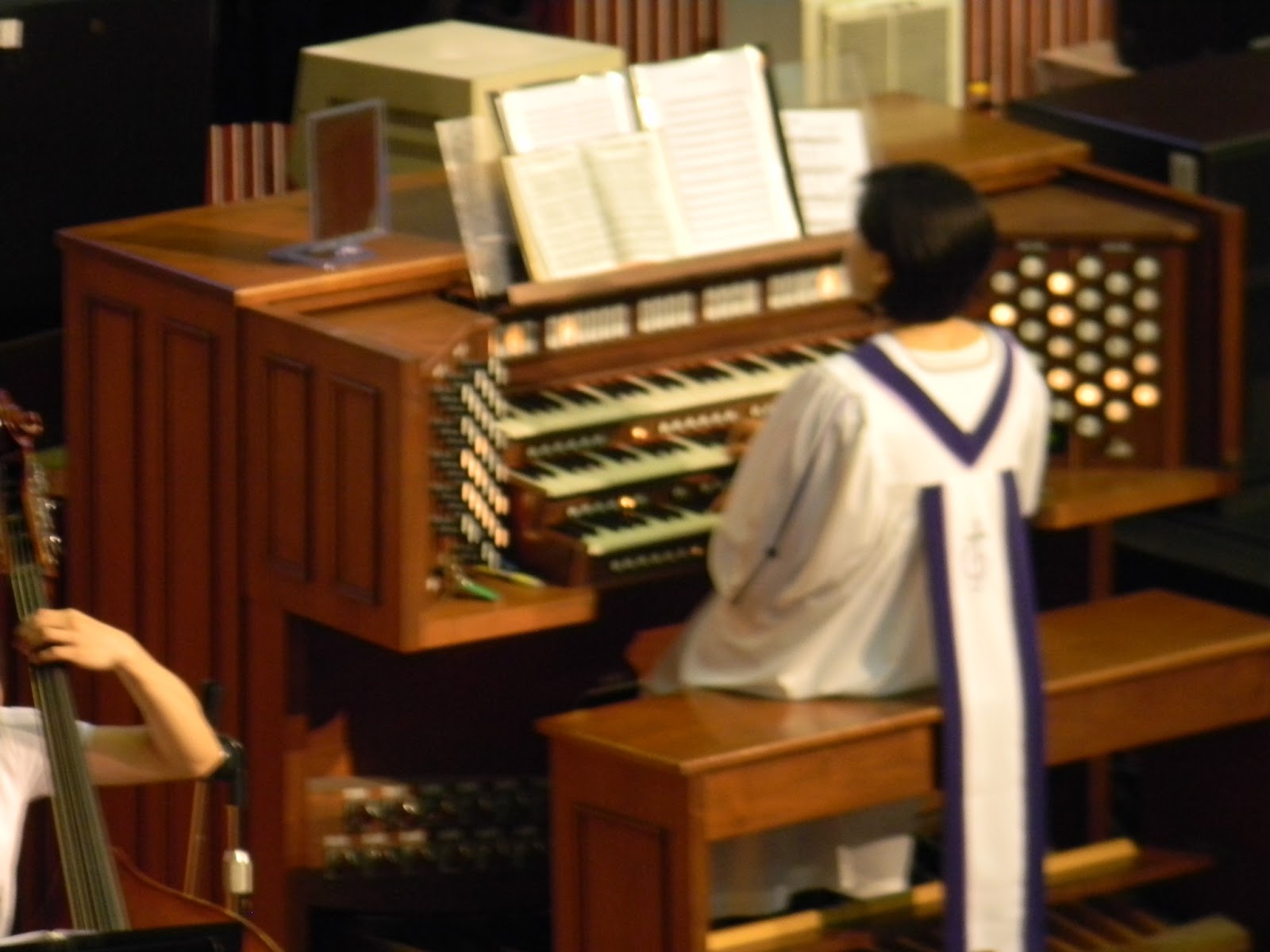
On the morning of our final day in South Korea, myself and a couple of others in the group decided to visit the early (7:00 AM) Sunday service at Yoido Full Gospel Church. Yoido is considered to be the world's largest Christian congregation (at 900,000+ members) and its main campus is in Seoul near the government's National Assembly building. Yoido has multiple weekend services at the main campus plus several satellite congregations. Yoido was on the early cutting edge of both the "cell group" (or small community study groups) and satellite campuses (similar to LifeChurch.tv in the United States).
"To move, to breathe, to fly, to float, To gain all while you give, To roam the roads of lands remote: To travel is to live." --Hans Christian Andersen
Sunday, July 14, 2013
Tuesday, July 9, 2013
Making the News in Korea
On July 6th, just after our final lecture at Korea University, myself and two other teachers, Robin Manning from the Austin, TX area and Kelly Webner from Miami, FL, were interviewed by The Chosun Daily. We were asked about our favorite moments of the trip and what specifically we will take back to our U.S. students. The article appeared in print on July 8th.
While it is in Korean (and I can't find it on their English version website), here is a link to The Chosun Daily article on the Korea Society trip. I have used Google's translator to try and make sense of the article. Based on those results, here is what I understand the translation to mean:
39 Teachers Visited Korea at the Invitation of the Korea Society
"Many students in the United States know very little about Korea, like a small puzzle piece. When I return I hope to share with them many more puzzle pieces to help them see the larger picture of Korea."
From the 26th of June through the 7th of July, 39 teachers came for a two week visit to Korea and will return home to share their experiences. David Burton (36) a high school social studies teacher from Moore, Oklahoma, USA, said "Most of our students only know about the Korean War and the division into North and South. I hope to share many other things about Korea." Burton specifically plans "to teach about Korea's economic development by using pictures of the POSCO steel plant."
Various academic and cultural exchanges were part of the Korea Foundation and Korea Society's program. The teachers visited museums and sites all throughout Gwanghwamun, Seoul, Gyeongju, Bulguska, and Cheongju. Robin Manning (58), a teacher at Jack Hays High School in Texas, USA, said "having her students read newspaper articles on Dokdo will help to organize discussions with her students" when she returns to the United States.
Running for about 25 years, the Korea Studies Program began in 1989. So far, more than 600 teachers from the United States have come to Korea. The program was first started when the eledest daughter of Choi Young Jin (70), Korea Society Vice President, was in high school. "Her teachers were not covering information on Korea in World History. China and Japan provided the basis of East Asian representations."
Noting that this is her first visit to Asia, Kelly Webner (33), a teacher at South Miami High School in Miami, Florida, USA, said that her "experiences will lead to expecting students understand the balance of traditional Confucian values with modernization as well as to know of Korea's pristine beauty."
Picture's caption: 39 American social studies teachers explored the campus of Korea University for five days as part of their two week good will visit to Korea.
Saturday, July 6, 2013
A Little "too far" to the North
A visit to the Korean Demilitarized Zone (aka "DMZ") is considered a once in a lifetime opportunity for most foreign visitors to Korea. Today was my second time to go...so I better not push my luck too much, huh?
We left our hotel a little before 10:00 and then proceeded to the Lotte Hotel/Shopping complex to pick up our guide for the day. We had a few minutes to browse through Lotte's duty free shops. My excuse for not buying a pair of uber sexy Louis Vitton shoes is that 9-1/2 was the largest they had and I needed 10-1/2; this decision was NOT due of the $960 price tag on them <grin>.
| Kelly helping heal the no-shoe pain |
| Lyn and Jess |
| Amber and David |
Leaving Imjingak, we made our way to Camp Bonifas which is located just south of the actual southern boundary of the DMZ. We were given a short introduction to the DMZ and Joint Security Area (JSA) and then boarded an official DMZ bus to continue on to Panmunjom. Crossing into the DMZ and driving toward Panmunjom, we could see the flags flying at each Daeseong-dong (aka "Freedom Village") in the South and Kijong-dong (aka "Propaganda Village") in the North.
| Kijong-dong village |
This portion of the Panmunjom visit which I made in 2009 did not occur. So while I have returned to South Korea and Panmunjom, this is my first time to enter North Korea. It's quite an emotional moment to be there. You know it's the "other side", the "bad side", and yet there you are without harm coming to you.
Leaving the building on "the line" we went back to the porch of Freedom House and had an opportunity to take pictures of Panmon Hall on the opposite side of "the line" from Freedom House. It's kind of chilling looking through your camera's zoomed-in lens to see a North Korea guard staring back at you through his binoculars. While the whole experience is tense due to the physical plot of land on which you are standing and knowing the history of the JSA and DMZ, it is also comforting to know that while we were in this place diplomatic conversations between North and South were occurring nearby to help resolve some of the recent tensions which resulted in the closing of the Kaesong Industrial Complex (located in the North and yet administered by the South--Northern employees and Southern employers).
In closing, all I can say is "wow" to this day of roaming the roads of lands remote!
Friday, July 5, 2013
Mommie to Be
This morning our study tour schedulers had determined that we would be free to explore on our own and at our leisure. We would then all reconnect at the hotel to be transported back to Korea University for our final two lectures.
But this morning's story starts LONG before we even arrived in Korea. One of our teachers from Chicago, Lyn, and her husband, Tom, began the process for an international adoption over a year ago. Eventually they learned that they were paired with a boy in Seoul. The process for adopting from Korea is a lengthy process to help insure accountability of all parties along the way. Lyn and Tom have, through their state-side agency, been in contact with the agency in Seoul. Pictures of their son-to-be have been exchanged. All of this pre-dates even the application process for this study tour.
A few weeks prior to our trip, something came up about possibly meeting her son at some point when Lyn might have time. Arrangements would have to be explored with the Seoul agency to see if schedules would even match up. Once our final "tentative" schedule was made Lyn was able to communicate when she would have the best opportunity. It was not until the day before we left when she and Tom received confirmation that an appointment for the morning of July 5th was set.
Lyn and I, along with a couple of other teachers made fast friends earlier on in the trip and Lyn mentioned this opportunity. I had mentioned that by luck of life I was with friends in Kenya when they formally began the process to adopt two precious children there and was able to take their first "family picture". Lyn then invited me and the other two to go with her: 1) to help be some form of emotional support for her because, in her words, she was going to be a "hot mess" and 2) to help take pictures and video for her to take back to Tom and their families. A couple of days later, after learning that he had previously adopted two Korean children through this very same Seoul-based agency, Lyn asked Professor Peterson to join us as well; his fluency in Korean would also help for translation.
So this morning, the five of us loaded into a couple of taxis and headed off to the Seoul agency for Lyn to meet her son in person. What an amazing time!! Lyn was able to meet and visit with her son's foster mom (who has already fostered three other children in preparation for an international adoption). Further, through the wifi connections at the agency, Tom was also able to meet his son through the wonders of "FaceTime" (as were Lyn's parents and sister). There was not a dry eye during the whole encounter. It was truly a special hour or so.
It will still be almost a year before the whole process is completed and Lyn and Tom are able to bring their son back to the United States. While Lyn and Tom have settled on a name for him (which includes his current Korean name) I am not mentioning it here as they have not communicated it to their family and I don't want them to hear about it from me <grin>.
Thursday, July 4, 2013
Monsooner or Later
Prior to our trip we had been told that our arrival would coincide with the beginnings of the rainy, or monsoon, season. While there has been a couple of short rain showers over the past week and a half and a gentle rain while at Haein-sa Temple, we had not yet experienced the truly HEAVY rains that we had been "promised".
Well, all of this changed last night. As groups were heading out to dinner following our check in at the hotel the rains changed from a some light sprinkling to a major down pour. It was the first time on the trip that I brought out my poncho and umbrella...yikes. Water was ankle deep in some locations.
The small group I was with (myself and three others) took refuge in the closest restaurant possible...Outback Steak House. It was sort of an "ideal" place so that we could have a taste of American on this Fourth of July while we hoped to ride out the rains.
Luckily the rains did subside long enough for some post dinner shopping and out return to the hotel.
Buddha on the Mount
Following the early morning departure from Daegu, we traveled about 1-1/2 hours to Haein-sa Temple. This Buddhist temple complex, nestled in the safety of Gayasan Mountain, is isolated enough to continue providing a legitimately meditative oasis and yet is close enough to Daegu and other accommodations so as to be convenient for visitors.
In the main courtyard, you will find a maze marked out on the ground (currently lined with lanterns to which written prayers can be attached). This maze coincides with a Buddhist poem that discusses the twists and turns that we experience in our quest to find "the way". Many in our group chose to walk the path of the maze, which should be accomplished in silence so as to allow your mind to focus on freeing itself of the distractions of life and focus simply on "the way."
Additionally, in the courtyard you will find the traditional temple platform which supports the bell, the drum, and other instruments used in summonsing all "sentient beings" to prayer. We were able to witness the summons which began with three monks taking turns on the drum; it was very intriguing the way that they would shift to the side as their turn was ending which would then allow another to slip in and to begin his turn without interrupting the sound.
As the monks made the transition from the drum to the bell a song which my church's choir sings began flowing through my mind: "Holy Spirit rain down..." All of a sudden this wonderful gentle rain began falling. It was so peaceful and just that extra "something special" to add to the moment.
As the sounds for the call to prayer, the three monks scurried off to join their brothers (and maybe sisters too, since female monks are allowed) who were already chanting their prayers prior to lunch. Our group respectfully followed behind so as to quietly enter the temple so as to observe some of the art on the walls. It is considered disrespectful to take pictures while actually inside the temple so I do not have images of the paintings depicting the traditional eight moments in the life of the Buddha. From outside of the temple, I was able to "zoom in" so as to get a couple of images of the Buddha statues.
Following our venture into the temple itself it was time for lunch. Arrangements had been made for us to dine in the cafeteria of the temple complex. There were to caveats for dining: 1) you must eat in total silence...no talking and 2) you may take as much as you like from the serving line to eat but you must finish every single morsel of food so as not to be wasteful. The selection include noodles, rice, cucumbers, spinach, a vegetarian sauce, watermelon, and tea. Even with chopsticks (and my soup spoon) I was able to fulfill the requirements for dining.
After lunch we hiked to the highest point in the temple complex to see the buildings which house Haein-sa's greatest treasure: the Tripitaka Koreana. The Tripitaka is the total sum of Buddhist scriptures carved onto 81,000+ wood blocks. From these wood blocks the scriptures can then be printed onto paper. The current Tripitaka collection is actually the second set of the scriptures made on wood blocks in Korea. The first was destroyed during the Mongol invasion and a second set was completed in 1252. Currently, visitors are not allowed to enter the specially designed buildings with serve as the library for the Tripitaka.
| from a photo display nearby the library hall |
Following another rain shower, we concluded our time at Haein-sa and began the four hour drive back to Seoul.
Foreign on the Fourth
Today marks the third time that I have been in active use of my passport on the Fourth of July. I've celebrated Independence Day in Kenya (2002), Germany (2011), and now South Korea (2013). On one hand each of these experiences have reminded me of the value of the freedoms and opportunities which I have as an American and on the other hand has made me truly realize that there is an amazing human spirit and overall interconnectedness among people which transcends nationalism and politically defined borders. So to my family and friends who will be celebrating today..."Happy Fourth of July!!"
Overnight we stopped in the city of Daegu, South Korea's third largest city (behind Seoul and Busan). While there were no defined study tour objectives, we did have time last night so as to explore. One of the things that we have noticed about Korean cities is that there are almost no single-family detached houses. All over the place, including the suburbs and even rural areas, you see high rise condominium buildings. We've been told that the ideal for a Korean family is to own a condo. We've joked amongst each other about these condo complexes all looking the same and parallels have been made to our suburban "Levittown" areas. Instead of little boxes on the hillside all made out of tickey-tackey like we see, you have high rise buildings on the outskirts all made out of tickey-tackey. So even without an official agenda, other than a hotel stay, in Daegu we have reflected upon Korean urban life.
Subscribe to:
Posts (Atom)