"To move, to breathe, to fly, to float, To gain all while you give, To roam the roads of lands remote: To travel is to live." --Hans Christian Andersen
As part of my upcoming trip to South Korea I am supposed to prepare a lesson to teach in an English speaking class at a local high school. The topics of our lessons was left open for each individual U.S. teacher. Something hit me that perhaps the recent events in the community of my school & students would provide an ideal platform for a lesson.
I began thinking about natural disasters and the way that communities respond and help each other to overcome the disaster. "Community" can be a very broad term to include just those in the immediate vicinity all the way to interpreting "community" as a common bond of human spirit across the planet. So that the lesson is relevant to my Korean students I don't want this lesson to solely focus on the F5 tornado which hit Moore, OK on May 20th. I've already begun researching natural disasters which have impacted the Korean Peninsula over the last decade or so: events which include a few typhoons (we call them hurricanes) and a massive flood in Seoul in 2011. I hope to work these events into the lesson so as to help my Korean students make local connection with international events; I also hope to refine and replicate this lesson for my students back at Southmoore.
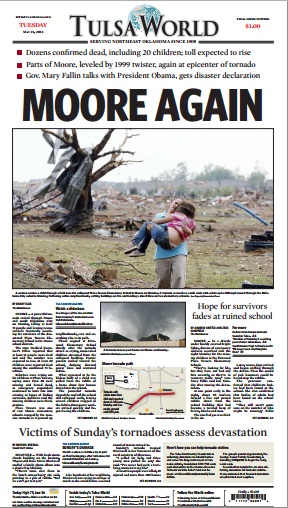
In preparation, I've found these images of front pages from newspapers in the aftermath of the May 20th tornado. The Newseum, my current favorite museum in Washington, DC, has archived these images on their website. I'm working on the best way to incorporate them into my lesson. If you have any constructive ideas to help flush out this lesson please leave them in the comments section below; honestly, your insight is greatly appreciated
Pereltsvaig, Asya. "The Deportation of Soviet Koreans and Its Reverberation in the Lyrics of Korean Songwriters." GeoCurrents. 29 May 2013. Web. 3 June 2013. Click Here for Article Link. (a special "thanks" to Robin Manning, a personal friend and a fellow on my upcoming Korea trip, who shared this article in our traveling team's Facebook group) Summary:
By the outbreak of the Bolshevik Revolution in 1917, approximately 85,000 Koreans were already living in eastern Russia. Such immigration had been encouraged so as to help populate and develop this region; an encouragement initially continued by the new Soviet regime. The thriving Korean community submitted an application for an autonomous region, similar to what had recently been granted to a Jewish community, but were denied. Due to suspicions of disloyalty, the Soviets created a plan to relocate this Korean population; by 1937 100,000 had been deported to Kazakhstan and another 74,000 were deported to Uzbekistan. With no food/shelter provided, thousands died in the extremely cold weather in the first three years of relocation. During World War II, arguing that they were really Japanese spies, many Koreans were forced into hard labor in mines and factories. Additionally, all forms of traditional Korean cultural, linguistic, and religious expression were forbidden. In the 1950s, Nikita Khrushchev allowed the Koreans to migrate at will within the Soviet Union. While many remained in central Asia, most migrated to urban areas; more than 80% of ethnic Koreans in Russia today live in cities. During this new policy of openness Koreans once again began to economically and culturally thrive. While most of the decedents of the initial Korean deportees are assimilated into Russia culture, there is still a strong resentment to the Soviet policies.
Today, two of the most well-known Russian Koreans are musicians who have made a name for themselves as the anti-establishment voices of their respective generations.
Yulyi Kim, his father was executed in 1937 as "an enemy of the people".
The judge at one with the prosecutor
Don't give a damn about detailed analysis,
All they need is to cover by talking
Their ready-made conviction.
Viktor Tsoi, paternal grandparents were original deportees
Changes! -- our hearts demand.
Changes! -- our eyes demand.
In our laughter and in our tears,
And in the pulsation of our veins:
"Changes! We wait for changes!"
Response:
Much of this deportation story makes me reflect upon a part of the larger American story, especially it's specific connection to the story of my home state of Oklahoma: Indian Removal. While the title "Trail of Tears" originated in the experience of the Cherokee Nation's forced removal to Indian Territory it is often used as the identifier of the larger story of relocation for all of the Southeastern tribes and is closely connection to the post-Civil War relocation of numerous other tribes, especially those of the Great Plains. Even with almost two centuries having passed since this initial round of forced relation, the pain and bitterness which is felt by decedents is just as strong as the that which is expressed by the two decedents noted here of the Korean relocation in the Soviet Union.
For me and the focus of "Global Education" which I place in my classroom, I see this story as another way to make historic and cultural connections between the stories of the "here" and the "there". While there are so many differences between the peoples of this great planet there are also a whole host of connections which truly link us into a more significant sense of community and unity than we often wish to admit.
This morning Daniel and I, along with Betty, Efa (Krida's principal), and Fikry (one of Krida's English language teachers), departed at 6:30 AM (yikes) to drive approximately 90 km to SMAN 1 Majalengka High School in Majalengka, Indonesia. While 90 km, or 56 miles, doesn't seem that far to those of us in the USA who can easily hope on an interstate highway and drive at 65 (or more) miles per hour, in Indonesia this distance takes MUCH longer to drive. Without stopping (no potty breaks, no photo opportunities, nothing), the morning drive took well over 2-1/2 hours.
By the time we arrived at SMAN 1 Majalengka, school had already started. As we got out of the Krida Mobile (actually one of the fleet of Krida's mini vans) we were greeted by a delegation of students (3 boys and 2 girls) who spent several minutes making small talk with us so as to practice their English skills. In time, a team of adults ushered us into the head master's office. I presented the head master with a small gift to thank he and his school for inviting Daniel and I to come and visit. We remained in his office for a while and visited.
student delegation who welcomed our arrival
giving SMAN 1 Majalengka's head master a gift: decorative plate with image of a Plains Indian
Approximately 30 minutes after our arrival, Daniel and I were each escorted to a classroom filled with students waiting for us to greet them and tell them about life in the USA. I was again able to use my prezi on life in Oklahoma to share with the students about our way of life. One of the slides which I have learned I need to move past rather fast includes the images of food in Oklahoma. Since Indonesia is a primarily Muslim country, most of the students are fasting during this current month of Ramadan. I can tell from the students' expressions when they see the images of food that it reminds them of their hunger so I try to make that part of the presentation as rapid as possible.
After the presentation and discussion, which included some good questions from the students especially about our animals and about the musicians from Oklahoma and favorite styles of music, I then passed out postcards to the students. I have run out of the cards written by my high school students at Southmoore and am now using the ones from the upper grades from Briarwood and Oakridge elementary schools. I have been promised by Betty that we will be visiting an elementary school or two either tomorrow or Saturday (yes, Indonesia has school on Saturday too) so I will make sure that most of these postcards get into the hands of elementary students here.
As the students were reading their postcards I began taking a few pictures of them. This led into a large group photo (there were about 50 students in this class) of the students with me. Immediately, the students start producing their cell phones with cameras and wanting me to pose with them as individuals or small groups for additional pictures. I felt like I was the newest movie star or pop musician visiting these children and that they ALL wanted to be photographed with me. I'll bet I was already appearing on Facebook before the class time was even over.
reading postcards from USA elementary school students
my geography class at SMAN 1 Majalengka
Speaking of Facebook, as the students returned to their seats for a time of questions and answers the first question requested my Facebook and twitter identification. I wrote the information for the Facebook page and twitter account that I use with my USA students on the white board. By the time I arrived back to the guest house at Krida, I already have 5 new "likes" on Facebook and 8 new followers on twitter. WOW...I am a rock star, LOL.
Following this class, the two boys who were part of the initial welcoming committee gave me a tour of the campus including the library, the students' parking lot, and the teachers' workroom. This school also has construction for a new lobby and I shared with the two boys that Southmoore was also under construction for some additional classrooms. Every chance I get I love to point out the similarities between my experiences in Indonesia and the USA; too often we focus on what divides us and not enough on what unites as a co-inhabitants of planet earth. It was now time to say our good-byes. We once again gathered in the head master's office for pictures and a parting gift: Daniel and I were each given a basket filled with mangoes.
main classroom building
on campus mosque
student parking lot; no cars, only motorcycles
library and media center staff
students showing their artwork to promote environmental protection
I am being presented a basket of mangoes as a "thank you" for visiting
As our group from Krida departed, I was surprised to see that we were driving off in a different direction. I made the assumption that there was an alternate route to get back to Bandung. After about 45 minutes of driving we turned around. Apparently Efa, who was driving, was trying to find a sate stand where Daniel, Betty, and I could get some lunch. However, due to Ramadan fasting he was not able to locate a stand. So on the way back into Majalengka we paused for about 15 minutes at a mosque so that Efa and Fikry could stop to pray.
Our journey continued en route back to Bandung. Eventually we did stop at Kentucky Fried Chicken (one of the few places open during lunch time) to eat. KFC was located in the same building as a grocery store so we also looked around in there for a few minutes. I saw some things I've never seen: Pepsi Blue, unusual fruits and vegetables, and the fresh meat and fish stand where the customers helped themselves to the unpackaged items rather than having an employee provide assistance in a more hygienic manner.
KFC staff is happy to serve you...but no mashed potatoes or mac & cheese
with your chicken, only french fries or a package of sticky rice
what is Pepsi Blue???
many of my Korean & Vietnamese students at Southmoore enjoy Durian
need frozen chicken nuggets or french fries? scoop them and bag them yourself!!!
It was after 5:00 when we arrived back at Krida. The return trip, if you remove the approximate time of an hour for the KFC stop, took over 5-1/2 hours. This should give an idea of how complicated driving is here in Indonesia. Vehicles of all shapes and sizes fighting for every inch on the road. A road paved for two lanes may have four or more lanes once the drivers decide for themselves how to accommodate their vehicles in the road. We were safe, but it just seemed to take "forever" to make the 90 km return trip. Oh well, tomorrow is another day.
video of the final road to Krida's campus; barely a
I just read a Facebook status update from Congressman James Lankford, Oklahoma 5th District, in which he commented about the "beautiful rain" which central Oklahoma is currently receiving. I submitted a reply to him: "The rain this morning is wonderful. I'm sitting at home (on Spring Break) with the front door open listening to the rainfall and feeling the coolness of the air."
I then had the realization that rain should be viewed as one of the great unifying factors throughout the world. We are all impacted by rain in some capacity. Some areas get too much. Some don't get enough. Others get just the right amount at the right time. Regardless of the quantity of rain, it is still something which impacts us all.
People so often look for reasons to draw distinctions between themselves and the "others". Gender, race, nationality, religion, wealth, physical abilities, etc., etc., etc., are classifications used to separate "us" from "them". I wish that we would all have a strong perference for looking at those things which show our similarities...things such as rain. The Christian scriptures attest to rain as a factor for unity: "[God] sends rain on the righteous and the unrighteous" (Matthew 5:45b). Whether rain is viewed as a good thing (typically be those who don't receive enough) or a bad thing (typically by those who get too much) it is something that when it falls it impacts all of us regardless of the distinctions we try to draw.
So while roaming the remote roads of life I encourage you to focus on those things which serve as indicators of the unity of humanity rather than those things which try to exhibit division.