Nearly every culture has some form of games unique to their culture or a modification of something similar in a neighboring culture. It is estimated that nearly 70% of Korean traditional games originated within the winter months; this seems logical since most people found themselves in doors to keep warm and needed something to help pass the evening hours.
I'm interested in learning, or a least seeing them in action, the following games:
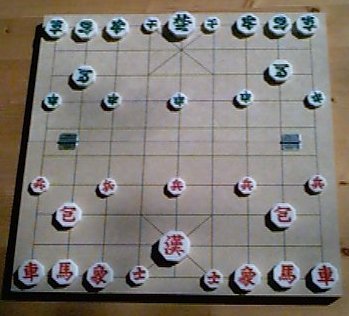
Janggi is the Korean version of chess which was introduced from Mesopotamia through the Chinese. Men can often be seen crouched over engrossing games along sidewalks and in parks. Each player has 16 pieces: 1 general, 2 chariots, 2 cannons, 2 horses, 2 elephants, 2 palace guards, and 5 soldiers, each of which is represented by Chinese characters written/carved on checkers. The object is to checkmate the general.
Baduk is a contest of wits between two players to occupy more territory (houses) on a board divided by 19 vertical and horizontal lines. Black and white button-like stones are used as the markers. Once exclusively the game of the high officials during the Goguryeo and Baekje days, baduk increased in public popularity after 1945. Baduk halls have now been established in almost every town.
Hwatu is the name given to Korean playing cards. A pack consists of 48 match-book sized cards, representing the 12 months of the year: January--pine tree, February--plum tree, March--cherry, April--bush clover, May--orchids, June--peony, July--iris, August--the moon, September--chrysanthemum, October--maple, November--paulownia, and December--rainfall. A bit of gambling often helps to spice up the game. These flower cards are also used for fortune-telling.
Yut is a form of backgammon that is often seen being played by old men sitting in the street. Four 10-inch sticks used as dice are tossed in the air, and the player moves his pawns according to the number of backs or faces that turn up on the sticks. The first player who gets all four of his pawns to a goal wins.
Yeon Nalligi, or kite-flying, has long been a pastime in Korea, both for children and adults. In the past, soldiers and the upper classes used fighting kites to hone their battle strategies. The goal of Korean kite fighting is to maneuver your kite so that it cuts your opponent's kite string (typically made of silk). A favorite location for kite flying is the Hangang Citizen's Park in Seoul (home of the International Kite Festival in the first month of the lunar year).
Game playing...one way to do some great remote road roaming!