Monday, July 1, 2013

Icons of Korean Language

Yesterday, Sunday, our group left Seoul early in the morning so as to begin our 5-day field trip into the southern provinces.  Following our 1-1/2 hour bus ride we arrived at our fist stop of the day: Yeongneung, or the tomb of King Sejong.  Sejong is the Korean leader credited for creating the Korean written alphabet, Hangeul, despite of scholarly debate as to whether he himself crafted the characters or if an advisory committee did so; Mark Peterson, our primary professor who teaches Korean Studies at Brigham Young University, contends that Sejong himself did so because many of this advising scholars were against the endeavor.  Sejong's work is not limited to language as he was also a key player in astronomy and developed a rain gauge, sundial, and other devices to measure wind and water.

The tomb itself is located in a park outside of the modern city of Yeoju.  To get to the burial mound you pass through a forest of twisted trees, walk past the small shrine in which ancestor remembrance ceremonies are conducted, and ascend the stairway to the top of a hill.  The tomb is inside a man-made mound similar to the mound-building cultures of North America's upper Mississippi River Valley (my friends in Oklahoma may have visited the mounds near Spiro).  Surrounding the tomb are life-size statues of soldiers, scholars, horses who are thought to have protected and accompanied Sejong's spirit into the afterlife.


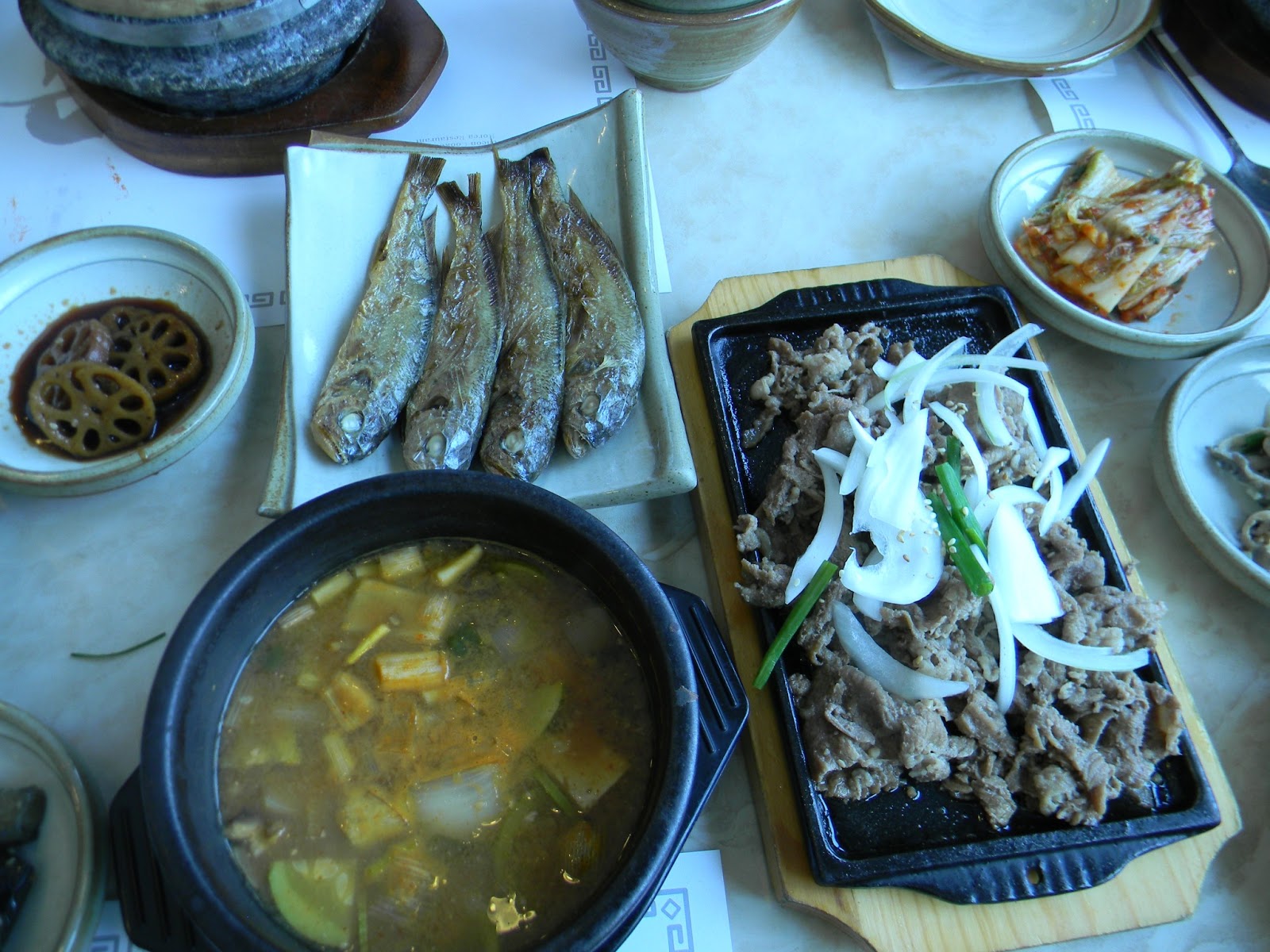
Leaving the tomb, we transferred to a bustling restaurant for lunch.  Plate after plate of Korean delicacies were placed before us...most were in a quantity primarily for tasting but the vast quantity of so many dishes/courses left me too full to truly enjoy the "main course" at the end.


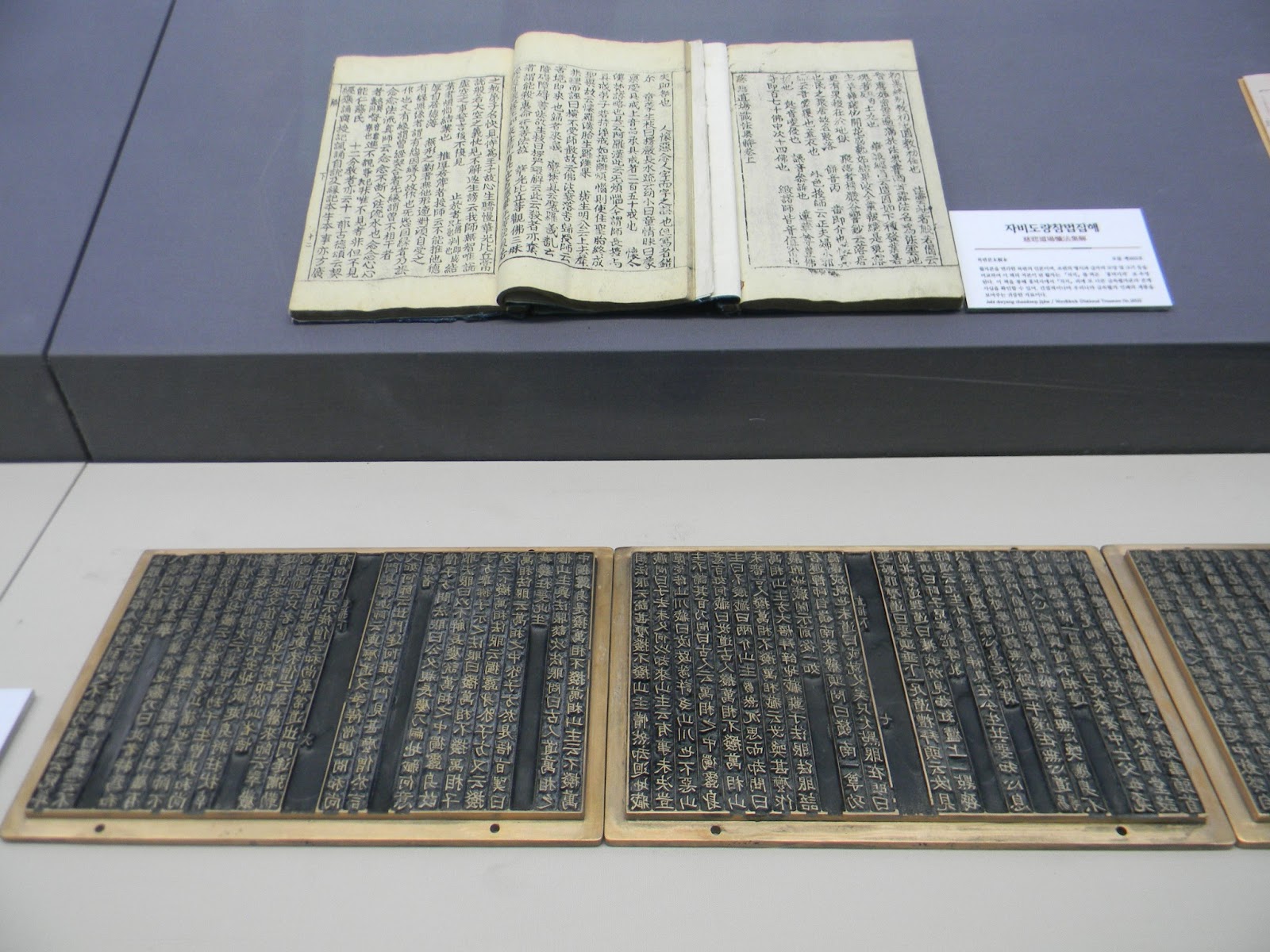
Another hour-long bus ride took us to the city of Cheongju.  As this growing city was the focus of much modernization a few decades ago and new construction was being complete.  During ground preparation, several relics were unearthed which gives credibility to the claim that an ancient Buddhist temple once stood on this site.  The Chinese markings on the relics carried the same name for the temple as noted in the Jikji.  The Jikji is owned by a French museum and is an example of early metal movable type printing which predates the Gutenberg printing press by 75+ years.  While the manuscript is still in French custody, this construction focus on this site shifted to creating the Early Printing Museum to honor both the significance of the Jikji and the history of metal movable type in Korea.


Following our exploration of the small museum itself, we teachers again became students and went through a hands-on demonstration of binding a book in the traditional Korean manner.  We used hard stones to impress a design on to our book covers, we "scooped" fibers/pulp out of water to make our paper, we rubbed paper to take on ink from a pre-set image, and then bound the book with string.  It was a pretty cool, and yet occasionally frustrating process (my paper didn't want to dry fast enough to satisfy my instructor).  We each left with our own book complete with the symbol for the Jikji stamped on the front.


It was rather cool to have both our stops in this process of remote road roaming connect with iconic expression of written language history within Korea.

Saturday, June 29, 2013

Dinner and a Show...WOW

Tonight we enjoyed a traditional Buddhist temple meal.  After wondering through the maze-like ally ways of the Insadong neighborhood of Seoul we entered a restaurant, or tea house, fashioned in the style of an old Buddhist temple.  After removing our shoes at the entrance, we were escorted to tables for which we sat on the floor (on flat pillows).  Massive quantities of food were already on the table for us and then more kept being brought out and/or being uncovered due to being previously hidden by food on a large flat board which had been set on top of a basket with more intrigues inside.  Following the consumption of mass consumables, there was a traditional dance performance.  Enjoy the pictures of tonight's dinner and a show:


Art Abounds

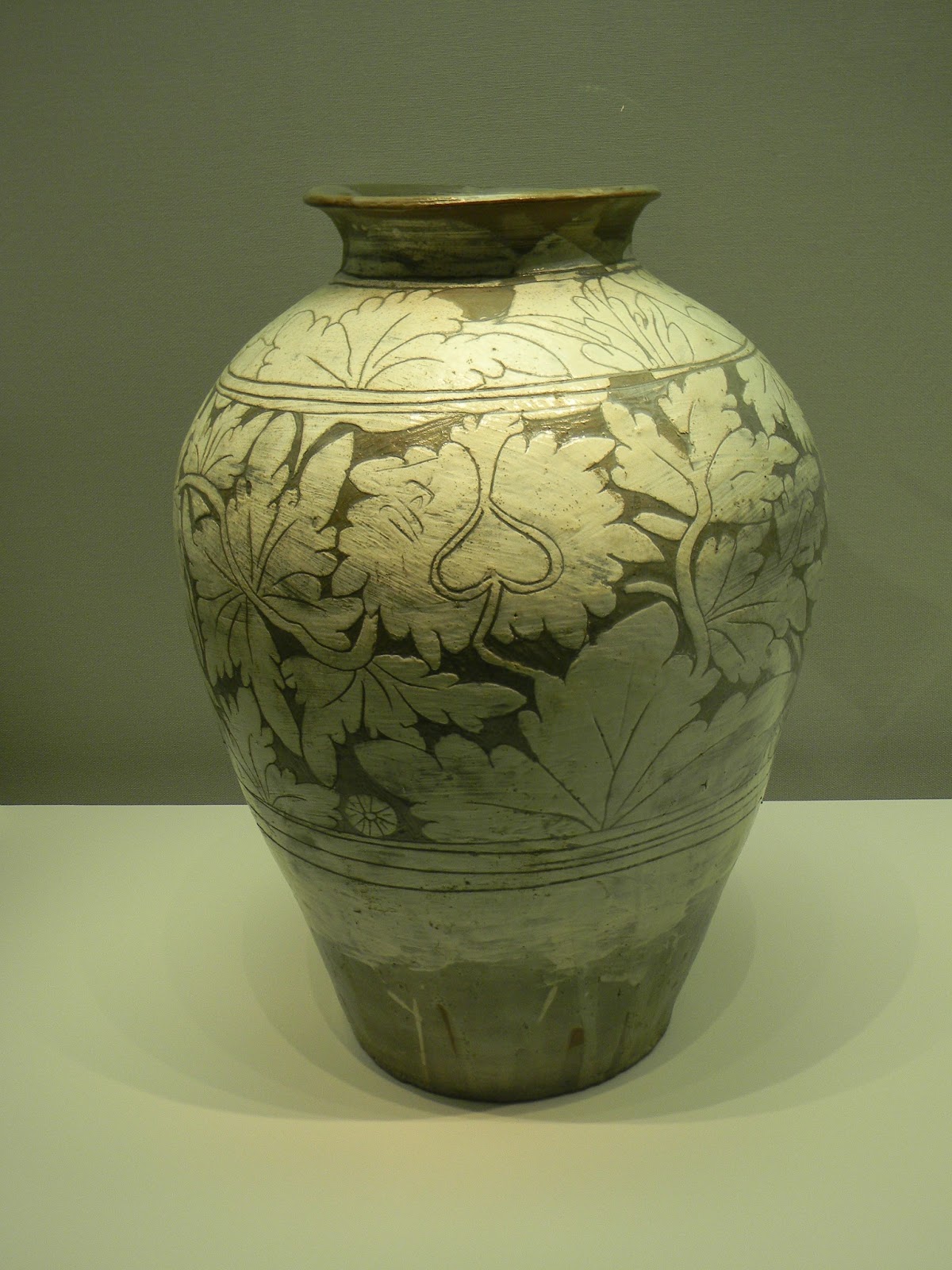
This afternoon we went to the Korean National History Museum.  The mammoth building has three stories housing the permanent exhibits plus much more space for traveling special exhibits.  Here is a taste of Korea's history through the artifacts in this museum:


Friday, June 28, 2013

Lectures...Round Two

I'll post professor pictures ASAP

During our second day at Korea University we had lectures/discussions on the following topics: Modern History, Society, Traditional Arts, and (following lunch in the university cafeteria) Cinema.

Modern History: While the session's title was geared to the modern era, it included background information on the legacy Korea's 2000 years of written history.  Nationalistic maps often portray the era of the "Three Kingdoms" as being much larger than they most likely were.  This era of "Three Kingdoms" might better be classified as the first era of a divided Korea (as compared with the current North-South split). The Choson Dynasty was 500 years and there are other examples of dynasties elsewhere in the world.  An interesting discussion focused on the heroes' images placed on currency: in Korea such are dominated by the Confucian scholars rather than key political or military leaders.  It was noted that there were three waves of the era of Japanese occupAtion and only the third (1931-1945, assimilationist era) in which Japanese behavior become deplorable and most Koreans truly developed a strong hatred.  The speaker's analysis contends that Gen. MacArthur is highly responsible for the current North-South split: his telegraphed ideas about an invasion of China during Korean War so as to oust Mao were intercepted and resulted in the Chinese invasion which caused UN/US/Southern forces to lose ground and shift back to armistice line.  A short discussion focused on "dictators" of the south which impacted economic development.

Society: The presentation began with a 21 minute video of the 1980s pro-democracy protest movements in South Korea so as to help contextualize the political society.  The discussion which followed focused on what could be an intriguing dynamic considering such a strong social push for increased democracy; there is a strong conservative perspective with a longing toward the leaders of the 60s-early 80s. Why might this be...not long after the political structural shifts there was some economic turmoil that occurred in the same era as the political liberalization.  The American montra of "it's the ecomomy, stupid" might help put the longing to the era of pseudo-democracy.  In the recent 2012 presidential elections, lower-class (economically frustrated) voters had a 65.7% bend toward the more conservative (era of less democracy and more governmental control of the economy) perspective.  It's little surprise that the daughter of one of the former president-dictators won the election, especially with a campaign making strong overtures to the success of her father's era.

Traditional Arts: A discussion which rapidly covered a progression of time using the various mediums of traditional Korean art.  Slides were shown of items used as examples as the era and medium being discussed.  One especially important aspect of the discussion which grabbed my attention involved the diffusion of culture, religion, and art from China to Korea to Japan: slides were shown of "National Treasure No. 83", a bronze bodhisattva statue made in Korea, connects with the diffusion of Buddhism from China into Korea and then a later, near identical, red pine statue found at a temple in Japan shows the continued diffusion of Buddhism on to Japan and yet in a Japanese traditional art form.  As Confucianism migrated into Korea the styles changed from elaborate to a more non-di script symbol design in white ceramics.

Cinema: Korean cinema has a troubled history often linked with strong censorship during both the era of Japanese occupation as well as the pseudo-democratic dictatorships.  Recent relaxing in censorship and international attention to domestic film festivals have advanced Korean cinema into international perspective.  Korea has 50+ university departments with degrees in film making.  Going to the theaters is big among viewers where as home viewing (DVD or online) is low.  40-60% of tickets purchased are for local films rather than those from other countries.  Many stars get their start on TV and then transition with popularity.  Korean films tend to be less ironic and more emotionally direct than films from other countries.